Thread Rating:
  • 1 Vote(s) - 5 Average
  • 1
  • 2
  • 3
  • 4
  • 5
Edge Retention/Rolling Test Stand
#71
We're on it Bud. Matter of fact we'll be back on it tomorrow morning having just manufactured yet another set of, hopefully, improved designed parts for the test stand. We hope to get a new report up on the Exchange yet this weekend.
#72
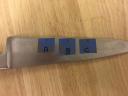
Here it is Bud. We had to come in this morning to finish this up because our Saturday didn't go exactly as planned. We think that we are about there with our test stand. We added a feature that allows us to move the impactor relative to the blade as opposed to vice versa. We think that we have to come up with a different name for the "impactor" because the term seems misleading. There is no "impact" in this test. We very gently and smoothly rolling the edge. The new set-up works superbly and our readings seem to reflect the improvement. We used the same old chef's knife we've been using but newly sharpened.  Grepper would be disappointed in us. We began in the 172 - 180 range this time. Another go with the Kally would have repaired that shortfall but we had other things in mind this time. Here's a picture of our test knife after the test. 
   

We're not going to bore you with before and after microscopic edge pictures this time because there is little discernible between the two in consideration of our new methods. Here is how we conducted the test this time and the procedure includes a new wrinkle this time. First, we established a total piston weight of 150 grams this time. Points "A" and "B" are redundant this time and serve only to verify results. In other words, we want A and B to yield similar results. A, B and C began life at similar sharpness levels. 180, 172, 172 respectively but we had something different in mind for C this time. We ground the apex of the edge down, at the C location, very slightly. Here's how we did it:
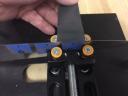
   

The abrasive piece is 5 micron S/C mylar backed polishing film. The sanding was conducted just as the picture indicates. Very slight pressure. When we were finished, C no longer measured 172 but then 239. We try to be very careful when performing this exercise. We sand, then we strop the edge, then we clean and measure edge sharpness. We then put the knife in the test stand and rolled the edge in precisely the same manner at all three locations. We roll about an inch long section of the edge and then measure around the middle of the roll. Here's how we measure these days; we measure once right on the mark and then a smidgeon left and a smideon right of the mark. We then average those three readings. The greatest differential within sets of three measurements was 11% and the smallest 0%. So, not bad at all. 

Here's how the tests came out:

A began at 180 and rolled to 300
B began at 172 and rolled to 295
C began at 239 and rolled to 301

Interesting isn't it? In this case, they all ended up at the same place regardless of initial sharpness level. Lots of different sharpness levels, sharpening variations and roll levels (piston weights) yet to be tested though. Now please keep this in mind when we talk about measuring the roll. We're not measuring (as in inches or mm) edge deflection. What we are measuring is how the roll affects the cutting ability (level of force) of the edge. That's what we're all interested in though, how rolling affects edge performance. If edges could roll 90 degrees and not affect edge performance we wouldn't care if edges rolled or not. 

We think test stand refinement is pretty much done. We need to test some other edge variables just to get a warm and fuzzy feeling about our new device and then we think we'll be ready for some crowd (BESSEX member) testing.

#73
Thank you EOU for the work you have put in on this. This is very interesting indeed. I think that this is going to answer a lot of questions about many things. First edge testers, then Rockwell and now this. What's going to be left to argue about?
#74
Got to tell you, this is starting to be fun. We went to lunch and were talking about the new test stand and where we should go next. We've already decided that we're going to let our member testers figure out how higher HRC edges fare but we decided that shouldn't keep us from testing lower HRC knives. We just happened to have a perfect knife for the purpose. It's a knife cut out of a sheet of .030" spring steel. 


Mcmaster Carr says that it is HRC 50. We sharpened the edge at 19 degrees (our test standard) and 140 sharpness. Then we rolled it exactly like the previous chef's knife test. After rolling, the edge tested 440, 458, 449 or an average of 449. That compared to the average 300 of the Henkel chef's knife which we assume is somewhere around HRC 55-57. There are a few differences here that may not make it quite a apples for apples test (specifically the behind the edge thickness is quite thin here) but the difference in roll is quite notable. 

A 300 point roll is sizable and we cold easily hook our fingernail on this one. Using a Sharp Pad we were only able to straighten it back to 228. We used me2's trick then using the spine of the Henkel knife and got it down to 198 but that was the end of the road.
#75
(02-18-2018, 01:19 PM)EOU Wrote: Here's how the tests came out:

A began at 180 and rolled to 300
B began at 172 and rolled to 295
C began at 239 and rolled to 301

(02-19-2018, 04:57 PM)EOU Wrote: After rolling, the edge tested 440, 458, 449 or an average of 449. That compared to the average 300 of the Henkel chef's knife which we assume is somewhere around HRC 55-57.

Just to play devil's advocate, is it possible from these test results we are effectively seeing another type of hardness testing, but instead of being an indent in the side of the blade, it is the actual edge hardness we are seeing?

My concern there would be that rather than actually see a different between steels, we will only see the actual edge hardness.

With the first test ending up at the same BESS score regardless of the starting condition, and the lower hardness steel ending up at a higher BESS for the same test conditions, it feels as if what is happening is that the steel is becoming deformed until the pressure applied can be supported by that deformed, widened pad of steel.

I'm very interested in this test, but this is what stands out to me from those results.
Tactical Reviews by Subwoofer
http://www.tacticalreviews.co.uk
Instagram @tacticalreviews
#76
Excellent thoughts subwoofer. You're not alone in your advocacy. We're all entering an area where no man has set foot before. We're all devil's advocates at this point. I can assure you, we have no agenda here and few theories. At this point, the only thing that we can tell you for certain is that we simply don't know. We hope that your speculation is correct, that we are testing edge hardness and/or durability because that is where the rubber meets the road in most applications. In fact, if your speculation is not correct then we are likely wasting our time here. 

We hope that there is a general correlation between hardness and edge durability (as this early test seems to indicate) because that doesn't rock the boat of conventional wisdom. We've rocked the boat before and it's no fun.  Assuming higher hardness steels roll less than softer steels then we get to explore all the other contributing factors like all the edge geometry issues, sharpening technique/methods etc.  Just quantifying the edge rolling characteristics of HRC 60 vs. HRC 62 is going to be interesting though. Then there are various steels that might both have identical hardness characteristics but do they resist rolling to different degrees? More combinations and permutations here than you can shake a stick at.

Our general goals with this device are simply this; to help separate reality from myth and to elevate speculation to a set of evidence based findings. That's the bottom line and thank you very much for your comments and participation here.
#77
[REPOST FROM All About Edges]  Thank you gentlemen! I appreciate your time in answering our questions. I can promise that our questions are not just idle "wonderings". As we continue to test edges with our new test stand we develop questions and we fall back on our friends who know more than we do to help answer them. The test stand demonstrates a very clear and measurable relationship concerning the amount of force applied to the edge, the number of iterations of the applied force and the beginning sharpness level of the edge. Our testing of individual knives seems to generally follow a somewhat intuitive course as well.  For example, we reported that our HRC50 1095 spring steel knife edge rolled almost twice that of our HRC56 Henkel edge. Makes sense. Or does it? We posted all the detail of this test over in the test stand thread. Our edge rolling element impinges on the edge at a 10 degree angle and moves linearly down the edge with only 150 grams of force applied. Why didn't the edge just "pop" back to, at or near, it's original position? Here's a few pictures of, not the same, but an identical duplicate of the spring steel edge we tested.

[Image: attachment.php?thumbnail=529]             [Image: attachment.php?thumbnail=530]                  [Image: attachment.php?thumbnail=531]    
      side view                               bent                                        return to straight
 
It certainly pops back in the pictures above. We're not so interested in why our 1095 spring steel didn't pop back as to what degree this springy effect either does, or does not, have on edge rolling. At first blush, not much. Our interest is heightened by Mark's references to the "toughness" of steels. It would seem that this toughness could be equated, on some level, with "springiness" so it could be explained then why a knife steel edge that was hardened to HRC65 and tempered to HRC56 might seem to roll less than a HRC61 edge (because the HRC61 edge isn't as tough). We're crossing bridges here before we come to them but wait, maybe we're not. We just tested a "Japanese" knife that was made in China. Supposedly HRC60-62 and did show some indications of being a harder knife according to its sharpening characteristics (and price). The edge rolled slightly more than the Henkel 55-57 knife. Lots of really interesting stuff to be figured out here.
#78
[REPOST FROM All About Edges] Thank you me2 for the explanation and definition of toughness. We just don't know. It simply perplexes us that so little force is required to permanently roll the edge. Keep in mind that the force we are applying is considerably less than the weight of the knife itself. We are applying that force in a very localized manner (the radius of a .75 inch diameter linear ball bearing) but still, nothing remotely close to cutting a frozen hot dog into two pieces. One possible explanation is that we are just crappy sharpeners and we advance that theory not just as some self effacing comment but as a genuine possibility. Another possibility is that edge apexes, via the sharpening process,  undergo  structural transformations that we don't yet understand. 

As an aside to this conversation, we tested a different Henkel knife. One with a much thinner blade than our chef's knife. We look at several different things but one of the things we are beginning to look at is the relationship between initial sharpness level and the amount of roll. So far, duller edges definitely roll less...and significantly less. This is not to say, however, that duller edges test sharper than their sharper counterparts after rolling. They do begin to test very similarly though post rolling. 

The method that we currently use to roll edges produces very undramatic microscopic pictures from a side perspective. There is little to see. We have begun to look at these edges "edge on" though with some success. Here's a couple of examples:

       [Image: attachment.php?thumbnail=532]                                            [Image: attachment.php?thumbnail=533]    
     Beginning BESS Score 152                                    Beginning BESS Score 360

This is the same knife edge at two different points on the edge. In the 152 picture we think that we can see the light reflected off the rolled edge and in the 360 picture we couldn't. This makes sense to us because the 152 edge rolled about 200 points while the 360 edge rolled only 60 points.

Well we've managed to move this conversation off topic so we're going to go ahead and post here but also pick up the last two or three posts and post them in the Rolling Edges thread as well to preserve continuity.
#79
Mr. EOU wrote;[i] "It simply perplexes us that so little force is required to permanently roll the edge." [/i]

I'm not at all surprised it takes very little to affect the edge, but better steel will be less affected. 

I will be very surprised if a 1000 grit edge won't roll less.

Maybe. JMHO.
#80
Well, we're just going to have to find out Mark. That question and a thousand others just like it with any luck.


Forum Jump:


Users browsing this thread: 4 Guest(s)