Posts: 592
Threads: 26
Joined: Mar 2017
Reputation:
0
I forge 12-16 knives per batch, so I have 4-5 knives in the kiln at a time, and use Park 50 at 100°F, for a 5 second quench to get full hardness out of very fine grain 52100. My soak is longer too, so I don't ever rush.
"Slow is smooth, smooth is fast". One of my favorite policies.
If I need to straiten an occasional blade I do it during the second temper, because I go strait to LN after quench.
Posts: 53
Threads: 1
Joined: Nov 2017
01-08-2018, 04:57 PM
(This post was last modified: 01-08-2018, 04:58 PM by scott.livesey.)
the Lindberg furnace is about 4.8 kw. the controller has been programmed for maximum element life, so 800C takes about 40 minutes.
"Many Kanthal heating coils are offered here for prices lower than the price of good quality Kanthal A1 wire necessary to coil them. I am afraid they are not made of quality wire." a good firm can afford to sell at lower prices because of volume. you are buying by the pound or less, they buy by the tonne.
Posts: 361
Threads: 11
Joined: Mar 2017
01-09-2018, 04:16 AM
(This post was last modified: 01-09-2018, 11:21 AM by Jan.)
It is really huge wattage, which probably requires 3 phase current. It is good to know that Lindberg protects the life of the heating elements by slowing down the heat-up rate. I will try to follow this approach.
Based on my considerations the full wattage would bring your furnace to 800 C within 10 minutes but at the cost of thermal shocks.
Modern high temp furnaces use molybdenum disilicide elements.
Buying Kanthal A1 wire, you are sure it is from Sandvik in Sweden. Winding the coils using the lathe is not very difficult.
Jan
Posts: 361
Threads: 11
Joined: Mar 2017
01-11-2018, 02:34 PM
(This post was last modified: 01-11-2018, 02:41 PM by Jan.)
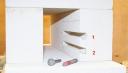
Inspired by a booklet "Compilation of Ideas to Promote the Highest Quality of Element Installation Practice", written and illustrated by Dudley F. Giberson, Jr., I have started experiments with grooving bricks.
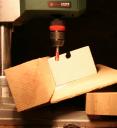
Both grooves were done using drill press and router bits. The first groove is a cylindrical niche and the second groove is an inclined slot, which could be better for heat escape from the groove.
Jan
Posts: 53
Threads: 1
Joined: Nov 2017
glad to see you went to the Joppa site and used some of his ideas. hope the grooved brick works well. when i upgrade my Paragon, I want to try elements supported by rods.
the Lindberg runs on US 240vac, 2 hots, 120vac each. I hope to some stainless blades soon.
Posts: 361
Threads: 11
Joined: Mar 2017
Joppa site is great source of info. Thanks for directing me there.
Jan
Posts: 53
Threads: 1
Joined: Nov 2017
the next items I would put on your shopping list is a second thermocouple and temperature display. first to verify the readings of your controller. second, to check the inside for hot spots and cold spots.
Posts: 361
Threads: 11
Joined: Mar 2017
01-12-2018, 02:56 PM
(This post was last modified: 01-13-2018, 03:47 PM by Jan.)
Mr. Scott thanks for your recommendations.
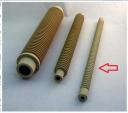
I have difficulties to accommodate the stretched element (spacing 3x wire diameter) into the side wall grooves. For this reason I am considering resistance wire holders made of porous cordierite, which are used in traction and resistance devices. One threated ceramic holder of 300 mm (or 12") length can accommodate 3 meters (or 120") of Kanthal wire. Depending on the wire diameter I would need 6 or 8 wire holders.
Jan
Posts: 361
Threads: 11
Joined: Mar 2017
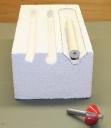
The third type of groove I am testing is a wider open groove which can accommodate the heating element coiled on a special ceramic wire holder. I hope this could be permanent solution without necessity to maintain the pin keepers holding the element in the groove. Nevertheless I have to discuss this solution with some kiln specialists.
 Jan
Jan
Posts: 592
Threads: 26
Joined: Mar 2017
Reputation:
0
I imagine you've already looked at the top two kiln manufacturers in the US, right?