


Mr. Mark, thank you very much for sharing your views, plans and also for mentioning the invitation to talk to university students at the Dakota School of Mines. Congrats, it is a great recognition of your achievements! 
My background is in Earth Sciences, although my original education was in solid state physics. I have overview of crystallography, atoms and bonding, esp. metal bonding and crystal defects – dislocations. Based on this I can comment some issues concerning physical properties of metals. My knowledge of metallurgy is only rudimental.
What concerns white and blue steel I have only general overview. I like white steel microstructure simplicity*. On the other hand white steel is known for narrow range of temperatures for hardening, requiring smith’s skill.
Tungsten present in the blue steel allows for smaller grains which may result in sharper edge. The tungsten carbides improve wear resistance and stiffness. Thanks to tungsten and chromium the interval of temperatures for hardening is for blue steel less critical.
Jan
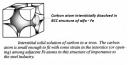
*P.S.: Carbon atoms added to iron are called interstitial atoms. C atoms are quite small (radius 0.07 nm) and so they can nicely fit in the spaces between much larger iron atoms (radius 0.12 nm).

My background is in Earth Sciences, although my original education was in solid state physics. I have overview of crystallography, atoms and bonding, esp. metal bonding and crystal defects – dislocations. Based on this I can comment some issues concerning physical properties of metals.
My knowledge of metallurgy is only rudimental. What concerns white and blue steel I have only general overview. I like white steel microstructure simplicity*. On the other hand white steel is known for narrow range of temperatures for hardening, requiring smith’s skill.
Tungsten present in the blue steel allows for smaller grains which may result in sharper edge. The tungsten carbides improve wear resistance and stiffness. Thanks to tungsten and chromium the interval of temperatures for hardening is for blue steel less critical.
Jan
*P.S.: Carbon atoms added to iron are called interstitial atoms. C atoms are quite small (radius 0.07 nm) and so they can nicely fit in the spaces between much larger iron atoms (radius 0.12 nm).