


More than year ago, as my own Christmas present, I have bought a School LCD Microscope with 3.5" display and 5 MP CMOS sensor manufactured by Bresser GmbH. (Germany). http://www.bresser.de/en/Microscopes-Mag...m-3-5.html
Comfortable is that it includes a mechanical desk with vernier. http://www.bresser.de/en/Microscopes-Mag...-Desk.html
It is solidly designed instrument with fully sufficient optical magnifications 50X, 125X and 500X. It works perfectly for thin biological samples which are illuminated from below and are viewed in transient light. See below an image of Tormek honing compound with 3μm grains. The image was taken in transient light at mag. 500X.

It does not work perfectly for bulky samples, like blades, illuminated from the top which are viewed in reflected light. In this case for large magnification the lens has to be very close to the blade and the field of view is very narrow and also the field of depth may be insufficient.
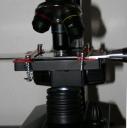
The LED illumination from the top is for our purposes also not ideal. Metallurgical microscopes use halogen lamps.
LED light is coherent and as such may be more prone to colour interferometric effects which then obscure the observation. My understanding is that the semi-regular grooves and scratches on the edge serve as a diffraction gratings causing the rainbow effect.
For standard edge inspection the magnification 125X is more than sufficient. Below you can see scratches on the edge of a new Morakniv.
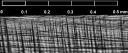
In the last image you can very see small chips in a blade made of WG-10 steel, which tends to be chippy. Magnification was 500X. It was difficult to use the maximum magnification because the objective overshadowed the object illuminated from above.
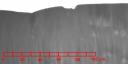
It is good to have a scale attached to the image. Sometimes the SW offers it, but in my case it was quite challenging DIY task. I am ready to share the know-how for it.
Jan
Comfortable is that it includes a mechanical desk with vernier. http://www.bresser.de/en/Microscopes-Mag...-Desk.html
It is solidly designed instrument with fully sufficient optical magnifications 50X, 125X and 500X. It works perfectly for thin biological samples which are illuminated from below and are viewed in transient light. See below an image of Tormek honing compound with 3μm grains. The image was taken in transient light at mag. 500X.
It does not work perfectly for bulky samples, like blades, illuminated from the top which are viewed in reflected light. In this case for large magnification the lens has to be very close to the blade and the field of view is very narrow and also the field of depth may be insufficient.
The LED illumination from the top is for our purposes also not ideal. Metallurgical microscopes use halogen lamps.
LED light is coherent and as such may be more prone to colour interferometric effects which then obscure the observation. My understanding is that the semi-regular grooves and scratches on the edge serve as a diffraction gratings causing the rainbow effect.
For standard edge inspection the magnification 125X is more than sufficient. Below you can see scratches on the edge of a new Morakniv.
In the last image you can very see small chips in a blade made of WG-10 steel, which tends to be chippy. Magnification was 500X. It was difficult to use the maximum magnification because the objective overshadowed the object illuminated from above.
It is good to have a scale attached to the image. Sometimes the SW offers it, but in my case it was quite challenging DIY task. I am ready to share the know-how for it.
Jan