Posts: 361
Threads: 11
Joined: Mar 2017
The glow of the chamber wakes up the feelings of a cave man in me.
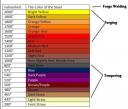
I am still waiting for the high temperature sensor. What I know about the temperature now is that it is far beyond 1350°F when steel loses its magnetism. For raw temp. estimation the colour of the heated steel can be used.
The kiln insulation is so good that very little amount of heat escapes, but if door is slightly opened the coffee cup would be nicely warm.

Jan
Posts: 500
Threads: 38
Joined: Mar 2017
We understand Jan. We couldn't sleep last night. Its like June in Alaska here in Arizona with that new glow emanating out of the East. Perhaps you could tinker on the kiln at night when we're all at work here.

We learned a little lesson about heat and magnetism ourselves. We make the vises used with the ME110 edge tester and press a rare earth (neodymium) magnet into the vise base. The first few runs we had the vise bases powder coated and then pressed the magnets in. We decided to get smart and press the magnets in to the base and then have the whole works, magnet and all, powder coated. Not smart. The 450F degrees generated during the powder coating process will apparently remove about 90% of the "stick" from rare earth magnets. As they say "live and learn".
We can't wait until you're fully up and running with your kiln project Jan. We have a feeling that we're all going to learn a great deal as a result of your projects and experiments with heat treating and tempering.
Posts: 361
Threads: 11
Joined: Mar 2017
02-08-2018, 11:03 AM
(This post was last modified: 02-09-2018, 06:39 AM by Jan.)
Mike, thanks for sharing this story. I am not surprised by the loss of the rare earth magnets magnetism.** Rare earth magnets are basically of two types neodymium magnets and samarium magnets. Neodymium magnets completely loss permanent magnetism at temp above some 600°F. Samarium – cobalt magnets completely loss permanent magnetism at temp above some 1300°F.
I think your magnets were made of neodymium.
The temperature at which materials lose their permanent magnetic properties is called Curie temperature (Tc). It is named after Pierre Curie, who was husband of Marie Curie known for her pioneering research on radioactivity. She was the first woman to win a Nobel Prize.
Jan
**P.S.: You can restore the permanent magnetism (correctly remanent magnetization) of a heated magnet by attaching it to a fresh rare earth magnet. Respect the polarity of the magnets.
Posts: 361
Threads: 11
Joined: Mar 2017
Mr. Mark and Mr. Scott, I would like to ask you about some practical aspects of knife steel heat treatment.
a) At what temp do you insert the blade in the kiln?
b) Do you use the heat treating foil?
c) How many preheat stages do you use and at what temps? How long do you hold the steel at that preheat stages?
d) Can cooking oil be used for quenching?
e) Is there some time delay between quenching and tempering?
Jan
Posts: 53
Threads: 1
Joined: Nov 2017
(02-10-2018, 04:32 AM)Jan Wrote: Mr. Mark and Mr. Scott, I would like to ask you about some practical aspects of knife steel heat treatment.
a) At what temp do you insert the blade in the kiln? for low alloy high carbon steel, 1475F/800C
b) Do you use the heat treating foil? no
c) How many preheat stages do you use and at what temps? How long do you hold the steel at that preheat stages? none, this is dependent on the steel you use and the source. I mostly use O1/1.2510 precision ground flat stock that is ready to be hardened without pre-heat
d) Can cooking oil be used for quenching? yes, I use canola/rapeseed oil heated to 120F/50C
e) Is there some time delay between quenching and tempering? you want to keep the delay as short as possible. I quench to room temperature then into ice water, scrub then into tempering oven.
Jan
Posts: 361
Threads: 11
Joined: Mar 2017
02-11-2018, 02:15 PM
(This post was last modified: 02-11-2018, 02:21 PM by Jan.)
Mr. Scott, thanks for your answers to my questions and for sharing your heat treating method.
Jan
Posts: 100
Threads: 11
Joined: Mar 2017
Jan, my process is pretty much identical to Scott's.
I use O1 tool steel heated to 1475-1500F and soak there for about 10 mins.
Also use vegetable oil from wal-mart, just because you can get gallons of it for pretty cheap.
I used a 'turkey deep fryer' pot for the quench oil because it was on the tall and skinny side - also from wal-mart.
Kind of nice because it comes with a propane burner for the preheat of the oil. And a lid, an important detail in the shop!
Another idea I found on the internet was to cut the top off a recycled argon or co2 welding gas cylinder for the quench tank, which I thought was pretty cool for knife work.
Happy heat treating!!