


It is good to distinguish between the tempering colours discussed in previous posts and the red hot colour sequence valid for steel at temperatures above 750°F.
Tempering colours are caused by a tiny oxide layer formed on freshly ground steel surface. Day light interferes in this film and the colour of the reflected light tells us about layer thickness and indirectly about steel temperature. This method works up to some 700°F.
The red hot colour sequence is caused by thermal radiation - glowing of the steel. It starts with heat red (more than 750°F) and continues to cherry red (1000-1400°F) to orange (1500-2000°F) to yellow, white and bluish.
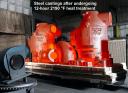
Colours were successfully used to judge the temperature for centuries by master blacksmiths working with wrought iron, but it is good to know how imprecise they can be.
Jan
Tempering colours are caused by a tiny oxide layer formed on freshly ground steel surface. Day light interferes in this film and the colour of the reflected light tells us about layer thickness and indirectly about steel temperature. This method works up to some 700°F.
The red hot colour sequence is caused by thermal radiation - glowing of the steel. It starts with heat red (more than 750°F) and continues to cherry red (1000-1400°F) to orange (1500-2000°F) to yellow, white and bluish.
Colours were successfully used to judge the temperature for centuries by master blacksmiths working with wrought iron, but it is good to know how imprecise they can be.
Jan

 Do you guys think that dragging a blade across a stone by hand sharpening can possibly raise the edge temp to 3600°F (2000°C) even for a few milliseconds?
 It may be something I just have to live with whilst making a determined effort to keep heating with its associated deleterious ramifications to a bare minimum.
