Posts: 592
Threads: 26
Joined: Mar 2017
Reputation:
0
Yes Sir, Jan! It's magnetic to about 1460*F -ish. 
TBH, I can't think of any knife steels, stainless included, that aren't magnetic.
There are probably as many titanium knives- mostly diving knives- as any other nonmagnetic blades, with the exception of ceramic.
I bet you know more than I do!
Thank you for your kind words and interest in forging and such! It's fun for me to have a niche here. 
Posts: 361
Threads: 11
Joined: Mar 2017
04-12-2017, 05:29 AM
(This post was last modified: 04-12-2017, 05:37 AM by Jan.)
Thank you Mr. Mark for your response. Yes, temperature kills ferromagnetism. Curie point, is the temperature at which materials lose their permanent strong magnetic properties.
Magnetism is quite a tricky property, which is a consequence of the steel's microstructure. For some applications (e.g. military, surgery) magnetic blades are not fully suitable. In principle ferritic stainless steels are magnetic while austenitic stainless steels are usually non-magnetic at room temperature.
Jan
Posts: 592
Threads: 26
Joined: Mar 2017
Reputation:
0
04-12-2017, 11:50 AM
(This post was last modified: 04-12-2017, 06:05 PM by Mark Reich.
Edit Reason: Needed editing loll
)
Thank You for visiting with me about about this Mr. Jan! It's very interesting to me to talk about steel from a metallurgical point of view.
"Austenitic" basically means "unable to be hardened, for lack of carbon", approximately? I think all 300 series stainless is like this, which makes me wonder why it's called "steel".
Something I've only recently heard, is that Hitachi White steel, which is only Fe + C, can only produce cementite, not martensite. Is that accurate?
We have a very good college an hour from here called the South Dakota School of Mines. The metallurgy Professor saw my wife's Reich Precision jacket, and noticed the "HEPK Mastersmith" line. He's familiar with Mr. Ed Fowler, and knows we work hard on 52100. He asked my wife if I'd be interested in talking to his class about blade metallurgy, and how I maximize 52100. I was totally shocked, but super interested! I plan on getting together with him this fall, when I'll have time to do it.
His class made a sword that took the national championship recently. I have a copy of the newspaper article, and I'm eager to speak with them about it.
As soon as I'm comfortable with my new shops and equipment, and get caught up with production, I'll be visiting with them all I can. I might even be able to take some classes and play with their electron microscope! I really want to know what size grain I'm producing, and whether a 24 hour soak in LN really converts 52100 to 100% martensite.
As any knife maker knows, heat treatment is the most important part of making high performance knives. I've worked my tail off to come up with my version for 52100, which I will put up against all comers, in any type of steel.
I have a video or two on my website that shows normal HEPK destruction tests. I do a couple things that allow me to exceed normal strength and durability, while maintaining equally high cutting performance.
I'm always anxious to learn more. I'm looking forward to expanding my horizons with laminated Hitachi Aogami Super Blue, and Blue #2 in Japanese style kitchen knives as soon as I am able. I have $9K worth of this steel straight off the boat from Japan, which is truly an unbelievable score.
Posts: 361
Threads: 11
Joined: Mar 2017
04-12-2017, 03:32 PM
(This post was last modified: 04-13-2017, 06:27 AM by Jan.)
Mr. Mark, thank you very much for sharing your views, plans and also for mentioning the invitation to talk to university students at the Dakota School of Mines. Congrats, it is a great recognition of your achievements!
My background is in Earth Sciences, although my original education was in solid state physics. I have overview of crystallography, atoms and bonding, esp. metal bonding and crystal defects – dislocations. Based on this I can comment some issues concerning physical properties of metals.  My knowledge of metallurgy is only rudimental. 
What concerns white and blue steel I have only general overview. I like white steel microstructure simplicity*. On the other hand white steel is known for narrow range of temperatures for hardening, requiring smith’s skill.
Tungsten present in the blue steel allows for smaller grains which may result in sharper edge. The tungsten carbides improve wear resistance and stiffness. Thanks to tungsten and chromium the interval of temperatures for hardening is for blue steel less critical.
Jan
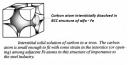
*P.S.: Carbon atoms added to iron are called interstitial atoms. C atoms are quite small (radius 0.07 nm) and so they can nicely fit in the spaces between much larger iron atoms (radius 0.12 nm).

Posts: 361
Threads: 11
Joined: Mar 2017
(04-12-2017, 11:50 AM)Mark Reich Wrote: Something I've only recently heard, is that Hitachi White steel, which is only Fe + C, can only produce cementite, not martensite. Is that accurate?
In my understanding cooling rate determines mutual proportions of martensite, cementite and ferrite formed. The critical cooling rate should be above circa 85°F/second.
Jan
Posts: 11
Threads: 0
Joined: Mar 2017
I don't mean to interrupt a good, in-depth, scientific discussion here but I do want to take opportunity to compliment Mark Reich and others on how you have shared such very interesting topics of the trade on this thread and others. I feel like I know you Mark because Mike has shared the content of many discussions he has had with you. I can promise that he holds you in very high regard. I don't have anything to add but I did want to say thank you for this forum. It's the best I've ever seen.
Posts: 260
Threads: 13
Joined: Mar 2017
Soxx
I, could not have said better what you just said in ref to Mark - Mark is so very special and the EXCHANGE is fortunate to have Mark.
Thanks, to both of you men from here in Louisiana.
Again as always
Rupert
Posts: 592
Threads: 26
Joined: Mar 2017
Reputation:
0
I can't Thank You enough for the kind and encouraging words, Gentlemen! Thank you for your interest in the larger picture!
It really means the world to me to be here, and I'm just very grateful for the opportunity to mingle with such an attentive, open minded group of Gentlemen.
Let's not forget the ones who have made this all possible! Mr. Rupert is the one y'all don't see working his tail off, but his selfless contributions run deeper than anyone knows. He is the glue that sticks people like Mike and me together.
I'm forever humbled and honored to be here, and so grateful for the opportunity to share what little I know with such a receptive group of new friends.
Thank you all, and special thanks to Mike. This is Awesome!
Posts: 21
Threads: 0
Joined: Mar 2017
That is one beastly forge! I don't know a darn thing about it but it is fun to see. Looking forward to further updates!
Pete in San Ramon
925-548-6967
Posts: 504
Threads: 55
Joined: Feb 2017
My first encounter with Jan was when he was restoring a mortising chisel originally used by his grandfather. Later, he worked on a sword ceremonially broken during the Austro-Hungarian Empire. I have always been impressed with both his math/science skills and his deep appreciation for edge tools and their history.
I am pleased to be part of this group which is both knowledgeable and very sharing of that knowledge.
Thanks.
Ken
|